
Parking Lot Lighting and Light Poles
LED fixtures, light poles and complete pole packages for commercial lots, with photometric design on request.
Home › Lighting Products › Parking Lot Lighting & Poles
A parking lot is the first thing a customer sees and the last place you want a trip hazard. LED Spot supplies the fixtures, the poles and the mounting hardware for commercial lots, and models the layout before you order so you know what the light will actually do. Browse the range below, or read on for help choosing.
Browse All Parking Lot Lighting and Poles
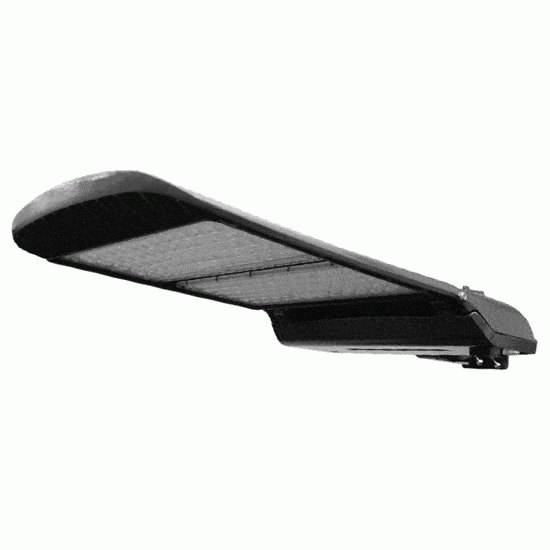
Type II, III and IV area lights and shoebox fixtures from 150W to 360W.
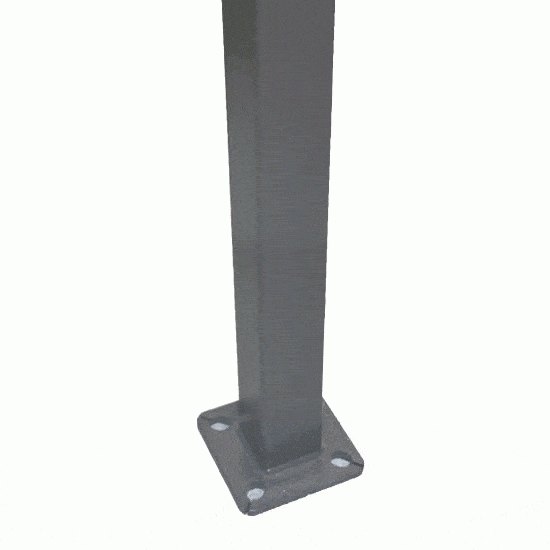
Steel and aluminum poles in round straight, round tapered, square tapered, straight square, galvanized, hinged and direct burial.
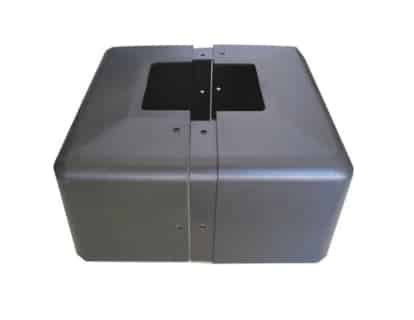
Tenon adaptors, bull horns, base covers, pole caps, knuckle and vertical mounts.
Single, double and quad fixture packages on 15ft to 30ft round and square poles.
What Does Quality Parking Lot Lighting Look Like?
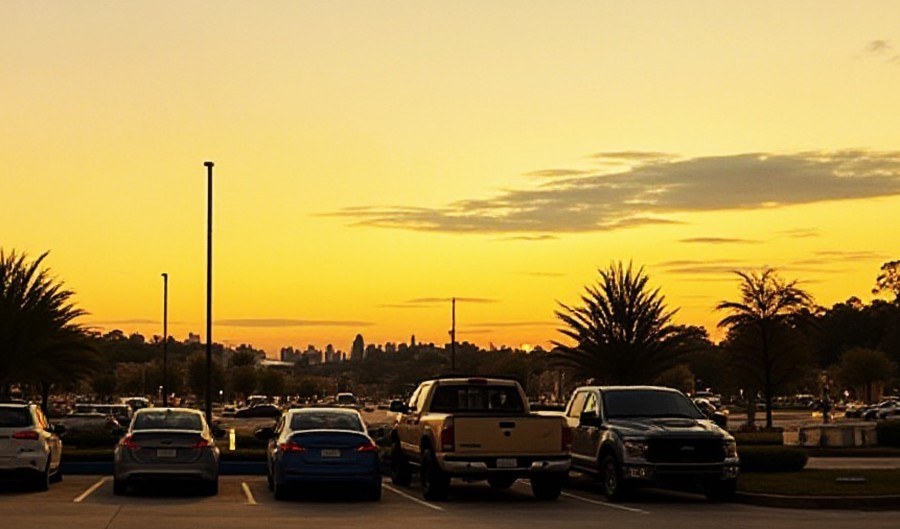
Laying out parking lot fixtures means solving two things at once: enough light at ground level that the surface is genuinely visible, and little enough spill that it stays off adjacent property, which many municipalities regulate by ordinance.
Those goals pull against each other, which is why the layout gets modeled rather than guessed. Photometric software places fixtures on a plan and measures the resulting light across the whole surface, so the foot-candle reading at any point is known before anything is ordered.
What Is the Difference Between Beam Angle Types?
LED fixtures are built in several beam distributions, and the type you choose decides where light lands and where it does not. LED Spot carries Type II, Type III and Type IV distributions across the LED parking lot lighting fixtures range.
Type II is long and narrow, a roadside distribution most often mounted along a lot perimeter. Type III throws further while staying narrow, with most output to the sides. Type IV throws further still, forward and sideways only, for the perimeter of large areas. Type V is omnidirectional like HID and belongs in the center of an open lot, never on the perimeter.
LED Area Light Fixtures
How Much Light Does a Parking Lot Actually Need?
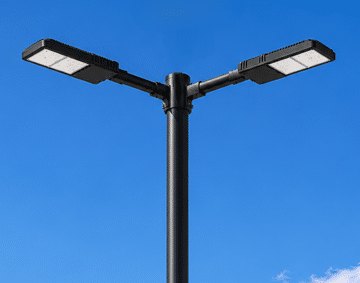
Brightness is measured in foot-candles at the surface, not in fixture wattage. Two numbers matter. The average maintained level across the lot is the obvious one. Uniformity, the ratio between that average and the darkest point, is the one people underestimate.
A lot lit to a high average with poor uniformity reads as less safe than a lot lit evenly to a moderate average, because the eye adapts to the bright pools and loses the shadows between them. Glare works the same way: a fixture uncomfortable to look at reduces what a driver can see rather than increasing it.
What Wattage and Color Temperature Should You Specify?
Wattage tells you what a fixture draws. Lumens tell you what it produces. Our guide to LED color temperature covers how Kelvin reads on site. For a retrofit the useful comparison is delivered lumens on the surface, not the wattage on the old fixture, because an LED aimed where light is needed replaces a much higher wattage metal halide that was throwing output everywhere. Voltage matters too, and multi-tap and universal voltage options exist for that reason.
Color temperature, or CCT, is given in Kelvin. Lower Kelvin reads warm and yellow, higher Kelvin reads cool and blue. Cooler temperatures render color well at distance, which helps long sightlines across a lot, but some municipalities cap CCT under dark sky rules.
How Do You Control Parking Lot Lights?

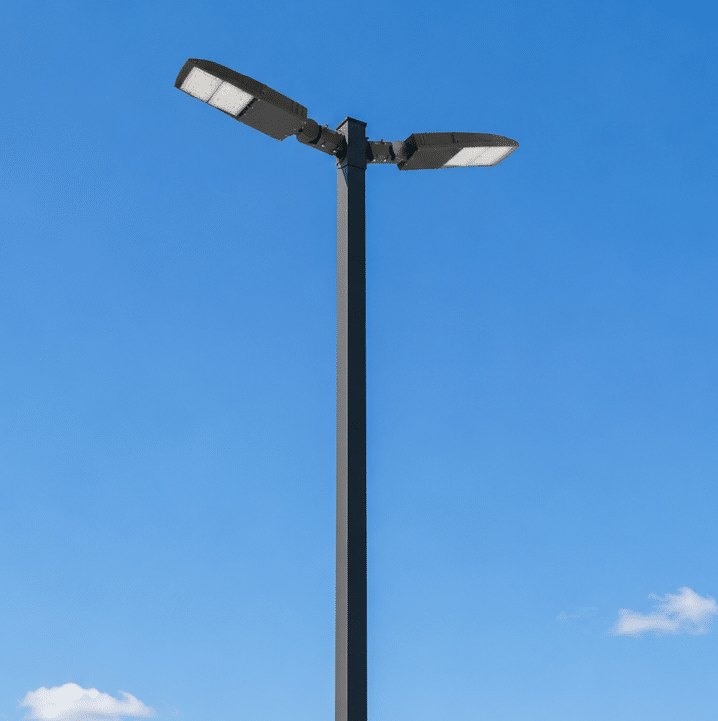
Once the fixtures are efficient, the remaining savings are in runtime. LED area lighting works with the full range of modern controls: photocells and sensors for automatic dusk to dawn switching, timers and scheduling for fixed operating hours, dimming including part-night dimming after peak, and motion sensors (PIR, ultrasonic and microwave occupancy sensors) that raise light levels when someone enters the lot.
What Poles and Mounting Hardware Do You Need?
Pole height, fixture spacing and beam type are one decision. A taller pole covers more ground per fixture and needs fewer of them, but it changes uniformity and the spill pattern at the same time.
Pole selection also has to account for the fixture EPA, the effective projected area the wind pushes against, and the wind loading where the lot sits. LED Spot supplies commercial light poles in steel and aluminum, in straight square, tapered round and direct burial configurations, with the tenons, brackets, base covers and slip fit mounts (slipfitters) to mount to them.
Pole Types
- Round Straight Steel Light Poles
- Round Straight Steel Galvanized Light Poles
- Round Tapered Steel Light Poles
- Round Tapered Steel Galvanized Light Poles
- Square Steel Tapered Light Poles
- Square Steel Tapered Galvanized Light Poles
- Straight Square Steel Light Poles
- Straight Square Steel Galvanized Light Poles
- Galvanized Hinged Straight Square Steel Light Poles
- Direct Burial Round Straight Steel Light Poles
- Direct Burial Round Straight Steel Galvanized Light Poles
- Aluminum and Decorative Light Poles
Mounting and Pole Accessories
- Round Pole Tenon Adaptors
- Square Pole Tenon Adaptors
- Horizontal Tenon Adaptor
- Knuckle Fixture Tenon Mount
- Horizontal Pole Mount Bracket
- Vertical Pole Mount Bracket
- Round Straight Bull Horns
- Round Curved Bull Horns
- Square Straight Bull Horns
- Curved Bull Horns
- Round Pole Base Covers
- Square Pole Base Covers
- Light Pole Caps
- Yoke Fixture Tenon Mount
Why Do Cheap Light Poles Fail?
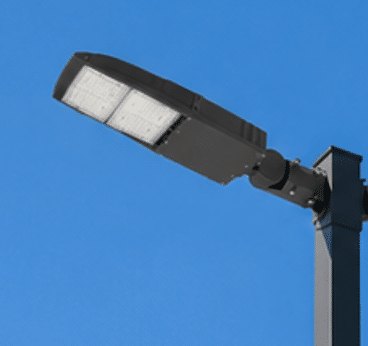
Wind is the load that decides a pole, not the weight of the fixture. Every fixture and bracket presents a surface for the wind to push against, and that surface area is expressed as EPA, the effective projected area. The pole has to be rated to carry the combined EPA of everything mounted on it at the design wind speed for the site. In coastal and hurricane-prone regions that design speed is high, which is why a pole specification that is perfectly adequate in a sheltered inland lot is not adequate there.
This is also why adding a second fixture to an existing pole, or swapping to a larger one, is not a free change. It raises the EPA and can push a correctly specified pole past its rating without anything looking different from the ground. Read more on fixture EPA and wind ratings.
Where the cheap pole actually gives way. Wall thickness is the first place cost gets cut, and a thinner gauge buckles just above the base plate where bending stress concentrates. The base plate and its welds are the second, since an undersized plate or a poor weld tears before the shaft ever does. The third is the anchor bolts, which corrode at the grout line where nobody inspects them.
Finish is a structural decision, not a cosmetic one. Hot dip galvanizing protects steel through the wall. Powder coat is a surface layer that protects only while it stays intact, so a chip from a mower or a door becomes a rust site that works inward. On humid coastal sites galvanized poles, often with powder coat over the top, hold up far longer than powder coat alone.
Direct burial versus anchor base. Direct burial costs less to install, but it moves the failure point underground where you cannot see it or service it. An anchor base pole can be inspected, re-torqued and replaced. LED Spot stocks both, in plain and galvanized light pole configurations.
A pole that fails takes its fixtures down with it, and it fails during the storm, which is exactly when the lot most needs to be lit and least wants a crew on site.
What Separates a Quality Fixture From a Cheap One?
Two area lights can quote the same wattage and behave nothing alike after two hot summers on an open lot. The differences are in the parts you cannot see from the parking space.
Thermal management. LEDs lose output and life when they run hot. A die-cast aluminum housing that is designed as a heat sink pulls heat away from the array. A thin stamped housing does not, and the fixture fades early even though nothing has failed outright.
Driver quality. The driver is the component most likely to fail first in any LED fixture. A quality driver holds current steady, tolerates the voltage swings and heat of an outdoor enclosure, and can be replaced rather than requiring the whole fixture to come down. Browse replacement drivers.
Sealing and ingress protection. An IP66 rating means the housing is sealed against dust and against water jets. Gasket quality and stainless hardware are what keep that rating true after thermal cycling. Water that gets into an optical chamber does not evaporate out, it sits on the array.
Serviceability. A fixture designed so the driver and the optic can be replaced in the field is a fixture you maintain. One that is sealed as a single throwaway unit is one you replace entirely, including the labor and the lift, the first time anything inside it fails.
What Do LED Spot's Parking Lot Fixtures Include?
Full cutoff design directs output downward to control glare and limit light trespass onto adjacent property.
Heavy duty housing in die-cast aluminum for strength and corrosion resistance, with stainless steel hardware and O-ring seals in the mounting arm.
IP66 ingress protection against water and dust, and an environmentally friendly polyester powder coat containing no VOCs or heavy metals for longer finish life.
Which Parking Lot Lighting Kit Fits Your Lot?
A kit is a matched package: fixtures, pole, crossarm and mounting hardware sized together so the parts arrive as one coordinated order rather than four separate decisions. Kits are specified by pole height, by how many fixtures sit on the pole, and by whether the pole is round or square.
Single fixture kits light a small lot or a specific bay. Double and quad configurations sit at the center of a larger lot and throw in two or four directions from one pole, which usually costs less installed than the equivalent number of perimeter poles.
If your lot is not a standard shape, individual fixtures and poles give more control than a packaged kit. Send the dimensions and we will model both.
LED Parking Lot Lighting Kits
- LED Double 15′ Round Pole Kit
- LED Double 15′ Square Pole Kit
- LED Double 20′ Round Pole Kit
- LED Double 20′ Square Pole Kit
- LED Double 24′ Round Pole Kit
- LED Double 25′ Square Pole Kit
- LED Double 30′ Square Pole Kit
- LED Quad 20′ Round Pole Kit
- LED Quad 20′ Square Pole Kit
- LED Quad 24′ Round Pole Kit
- LED Quad 25′ Square Pole Kit
- LED Quad 30′ Square Pole Kit
- LED Single 15′ Round Pole Kit
- LED Single 15′ Square Pole Kit
- LED Single 20′ Round Pole Kit
- LED Single 20′ Square Pole Kit
- LED Single 24′ Round Pole Kit
- LED Single 25′ Square Pole Kit
- LED Single 30′ Square Pole Kit
Pole Light Packages
Why Switch From Metal Halide to LED?
Energy. LED is the most efficient source available, and the advantage grows at system level because an LED can be aimed without losing significant output.
Light quality. LED fixtures emit evenly, so coverage has no dead spots, and they render color well at night, which is what makes distant objects readable across a dark lot.
Maintenance. Solid-state fixtures need essentially no routine attention and hold their output far longer, so relamping cycles stretch out or disappear.
Frequently Asked Questions
Brightness is measured in foot-candles at ground level, not in fixture wattage. Most commercial lots are designed around an average maintained level plus a uniformity ratio that keeps the darkest point within a set range of the average, because an even wash of moderate light reads as safer than bright pools separated by shadow. The right target depends on the use of the lot, its surroundings and any local ordinance, which is what a photometric drawing settles before anything is ordered.
Type II and Type III distributions suit perimeter mounting, where light needs to run along an edge rather than spread in all directions. Type IV throws further forward and to the sides and works on the perimeter of larger lots. Type V emits omnidirectionally and belongs in the middle of an open lot, never on the edge, where it would spill onto neighboring property.
Correlated color temperature, or CCT, is measured in Kelvin. Lower numbers read warmer and yellower, higher numbers read cooler and bluer. Cooler temperatures render color well at distance and are common in commercial exterior lighting, though some municipalities cap CCT to limit skyglow. Check before specifying if your area has a dark sky ordinance.
Full cutoff fixtures direct light down rather than out and sideways, which controls both glare and trespass. Mounting height, beam type and spacing all affect where light lands, and a photometric layout shows the spill pattern at the property line before a single pole goes in the ground.
Yes. LED fixtures work with dimmers, timers, photocells for dusk to dawn switching, and occupancy sensors including PIR, ultrasonic and microwave. Controls are usually where the remaining energy savings sit once the fixtures themselves are efficient.
Pole height, fixture spacing and beam type are one decision, not three. A taller pole covers more ground per fixture and needs fewer of them, but it also changes uniformity and the spill pattern. Pole selection also has to account for the fixture EPA and the wind loading in your area.
Yes. Photometric design is available on request. Send the lot dimensions and we will model fixture placement and show light levels across the surface before you commit to a package.
Retrofitting metal halide to LED pays back because metal halide loses lumens steadily across its life and sends energy in every direction, including up. LED delivers output where it is aimed, holds that output far longer, and works with controls that cut runtime further. In practice a like for like LED system draws meaningfully less energy and needs attention far less often.
Parking Lot Lighting Guides and Resources
A step-by-step checklist for a complete light pole order, from pole type and height to shaft size and wall gauge.
How to choose a pole: pick the fixture and bracket, look up the fixture EPA, then match pole height to the wind load at your site.
What changes when metal halide parking lot fixtures are replaced with LED, from energy use to maintenance.
Why lighting is a key safety layer in parking garages, and what to look for in fixtures for covered parking.
Why pole wind ratings matter, and how complete pole and fixture packages ship to the job site.
Photometric Design
Send your lot dimensions and we will model fixture placement and show the light levels across the surface before you commit to a package.
Ready to Light Your Lot?
Request a quote on any fixture, pole or package, or call and talk it through with someone who specs these every day at (281) 972-5006.